

Introduction
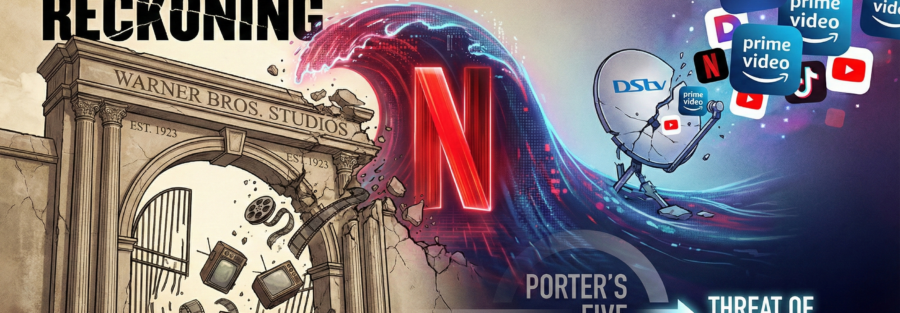
In December 2025, Netflix announced an $82.7 billion deal to acquire Warner Bros. Discovery’s film and streaming assets, marking one of the most seismic shifts in entertainment history (Reuters, 2025). This acquisition represents more than a corporate transaction—it’s a cautionary tale about Porter’s “threat of new entrants” force and the existential risk facing companies that fail to embrace digital transformation. Warner Bros., a studio with over 100 years of Hollywood legacy, has become the latest victim of digital disruption, while halfway across the world, South Africa’s DStv faces a parallel crisis that underscores the same brutal truth: adapt digitally or be overtaken.
Warner Bros: A Century of Legacy Meets Digital Reality
The Storied History
Founded on April 4, 1923, by four brothers—Harry, Albert, Sam, and Jack Warner—Warner Bros. established itself as a cornerstone of American cinema (Variety, 2023). The studio pioneered synchronized sound with “The Jazz Singer” in 1927, produced cultural landmarks like “Casablanca,” and built an empire spanning film, television, and animation. For a century, Warner Bros. represented Hollywood’s golden standard, creating franchises from Batman to Harry Potter that defined generations (Forbes, 2023).
The company’s 102-year journey was characterized by continuous adaptation—from silent films to talkies, black-and-white to color, theatrical to television. Yet when the digital streaming revolution arrived, Warner Bros. hesitated at the critical moment (NDTV Profit, 2025).
The Fatal Hesitation
Warner Bros. Discovery’s downfall wasn’t immediate—it was a slow erosion caused by underestimating Porter’s “threat of new entrants.” When Netflix launched streaming in 2007, traditional studios dismissed it as a niche distribution channel. By the time Warner Bros. launched HBO Max in 2020, Netflix had already captured 200 million subscribers globally and fundamentally reshaped consumer expectations (Time, 2025).
The studio’s hybrid approach—maintaining theatrical windows while developing streaming—proved too little, too late. As the BBC (2025) reported, Netflix’s acquisition includes Warner Bros.’ entire studio and streaming business, effectively ending over a century of independent operation. The message is clear: in the digital age, legacy alone cannot protect market position.
Porter’s Five Forces: The Threat of New Entrants
Understanding the Force
Michael Porter’s “threat of new entrants” examines how easily new competitors can enter an industry and erode established players’ market share and profitability (Panmore Institute, 2024). Traditionally, the entertainment industry had massive barriers to entry: production infrastructure, distribution networks, talent relationships, and capital requirements created a protective moat around studios like Warner Bros.
Digital technology obliterated these barriers.
How Netflix Became the Disruptive Entrant
Netflix entered as a DVD rental service but recognized that digital distribution would democratize content delivery. The company invested heavily in streaming infrastructure, data analytics, and original content production—essentially building a new entertainment model from scratch (IBS Americas, 2025).
Key advantages Netflix leveraged:
- Low distribution costs: Digital streaming eliminated physical distribution expenses
- Global reach: Internet connectivity enabled instant worldwide access
- Data-driven insights: Viewer analytics informed content decisions with unprecedented precision
- Direct customer relationships: Subscription models bypassed traditional intermediaries
- Agile content strategy: Algorithm-driven recommendations personalized experiences
By the time traditional studios recognized the threat, Netflix had already established dominant market position, accumulated massive subscriber data, and created a content library that rivaled century-old studios (Medium, 2024).
The Digital Transformation Imperative
Porter’s model reveals a harsh reality: when barriers to entry collapse, incumbents must transform or perish. Warner Bros.’ mistake wasn’t failing to enter streaming—it was entering half-heartedly while protecting legacy theatrical and cable revenue streams. This hesitation allowed Netflix to consolidate its position as the category leader (LinkedIn, 2024).
The acquisition demonstrates that in digital markets, “new entrants” can not only compete with but ultimately acquire established players. Netflix, founded in 1997, has purchased Warner Bros., founded in 1923—a stunning reversal that would have been unthinkable two decades ago.
The South African Parallel: DStv’s Streaming Crisis
MultiChoice’s Subscriber Collapse
The Warner Bros. story finds a striking parallel in South Africa, where DStv operator MultiChoice has experienced catastrophic subscriber losses. According to MyBroadband (2025), MultiChoice lost 2.8 million subscribers between March 2023 and late 2024, declining from 17.3 million to 14.5 million subscribers—a 16% drop in just 18 months.
More recent data from Canal+ shows the decline accelerated, with an additional 1.2 million subscribers lost between March 2024 and March 2025 (Moneyweb, 2025). This represents a “death by a million cuts” as South African consumers abandon traditional satellite television for streaming alternatives.
The Streaming Variety Advantage
DStv’s crisis mirrors Warner Bros.’ predicament: failure to fully embrace digital transformation while new entrants captured market share. South African consumers now have access to:
- Netflix: Global content library with local productions
- Amazon Prime Video: Competitive pricing and international content
- Disney+: Family-friendly content and Marvel/Star Wars franchises
- Showmax: MultiChoice’s own streaming service, but launched too late with insufficient differentiation
- YouTube: Free, ad-supported content competing for attention
These platforms offer superior value propositions: lower costs, on-demand viewing, multi-device access, and personalized recommendations. DStv’s traditional satellite model—expensive packages, scheduled programming, limited device flexibility—cannot compete with streaming’s convenience and variety (Daily Investor, 2024).
Porter’s Forces in the South African Context
The DStv situation perfectly illustrates the “threat of new entrants” force:
- Low barriers: Streaming services enter South Africa with minimal infrastructure investment
- Price competition: International platforms leverage global scale to offer competitive local pricing
- Content variety: Aggregated global libraries surpass DStv’s regional content
- Consumer power: Digital natives demand flexibility that satellite TV cannot provide
- Switching costs: Minimal penalty for consumers to cancel DStv and subscribe to multiple streaming services
MultiChoice’s belated response—launching Showmax and reducing DStv prices—demonstrates reactive rather than proactive strategy. Like Warner Bros., the company protected legacy revenue too long, allowing new entrants to establish dominant positions (Consumer Connect, 2024).
Strategic Recommendations: Surviving Digital Disruption
For Traditional Media Companies
1. Embrace Digital-First Strategy Companies must prioritize digital channels over legacy distribution, even if it cannibalizes existing revenue. Half-measures fail—full commitment to transformation is essential.
2. Invest in Technology Infrastructure Build proprietary streaming platforms, data analytics capabilities, and personalized recommendation systems. Technology is no longer support infrastructure—it’s core competitive advantage.
3. Leverage Existing Assets Strategically Content libraries, production expertise, and talent relationships remain valuable. However, these must be deployed through digital-first distribution models, not protected through outdated windowing strategies.
4. Develop Direct Consumer Relationships Eliminate intermediaries and build direct subscription relationships. Consumer data becomes the foundation for content strategy, marketing, and product development.
5. Form Strategic Partnerships Rather than competing alone, consider partnerships that strengthen digital positioning. MultiChoice’s acquisition by Canal+ represents recognition that scale matters in streaming wars.
For South African Market Specifically
1. Localized Content Strategy DStv should double down on African content production—the one area where global streamers remain relatively weak. Original local productions create differentiation that international platforms cannot easily replicate.
2. Flexible Pricing Models Introduce micro-subscription options, day passes, and pay-per-view models that compete with streaming flexibility while acknowledging South African economic constraints.
3. Infrastructure Partnerships Collaborate with telecommunications providers to bundle streaming services with data packages, reducing the cost barrier for consumers.
4. Sports Rights Protection Maintain exclusive rights to premium sports content—particularly South African rugby, cricket, and soccer—which remains a key differentiator versus international streaming platforms.
5. Technology Modernization Invest heavily in Showmax’s technology platform, user experience, and content recommendation algorithms to match international streaming standards.
Conclusion: The Unforgiving Nature of Digital Transformation
The Netflix-Warner Bros. acquisition and DStv’s subscriber crisis tell the same story: in the digital age, the “threat of new entrants” force is existential. Companies that hesitate, protect legacy revenue streams, or pursue half-hearted digital strategies will be overtaken by agile, digital-native competitors.
Warner Bros.’ century of legacy could not protect it from a company founded 74 years later. DStv’s dominance of African pay-TV markets for decades cannot shield it from global streaming platforms. The lesson is unambiguous: digital transformation is not optional, and partial commitment is insufficient.
As Porter’s framework demonstrates, when barriers to entry collapse, incumbents must fundamentally reinvent themselves or face irrelevance. The companies that survive will be those that embrace digital disruption completely, immediately, and without reservation—recognizing that in the digital economy, yesterday’s legacy is no guarantee of tomorrow’s survival.
References
BBC News. (2025). Netflix to buy Warner Bros film and streaming businesses. Retrieved from https://www.bbc.com/news/articles/ce91x2jm5pjo
Consumer Connect. (2024). MultiChoice loses 2.8m subscribers as South Africans dump DStv. Retrieved from https://consumerconnectng.com/48269
Daily Investor. (2024). DStv under siege. Retrieved from https://dailyinvestor.com/technology/113132/dstv-under-siege
Forbes. (2023). 100 Years Of Warner Bros.: A New Documentary. Retrieved from https://www.forbes.com/sites/allysonportee/2023/05/25/
IBS Americas. (2025). Porter’s Competitive Strategy: Netflix Case Study. Retrieved from https://ibs-americas.com/en/contents/publications/articles/31/
LinkedIn. (2024). Digital Transformation view of Porter’s Model. Retrieved from https://www.linkedin.com/pulse/digital-transformation-view-porters-model
Medium. (2024). Porter’s Five Forces in the Digital Economy. Retrieved from https://medium.com/@ashritkumardash/porters-five-forces-in-the-digital-economy
Moneyweb. (2025). New Canal+ data shows MultiChoice subscriber losses accelerated. Retrieved from https://www.moneyweb.co.za/news/south-africa/
MyBroadband. (2025). Death by a million cuts — South Africans say goodbye to DStv. Retrieved from https://mybroadband.co.za/news/broadcasting/620963/
NDTV Profit. (2025). Tracing Warner Bros’ 102-Year Journey As Netflix Writes Final Chapter. Retrieved from https://www.ndtvprofit.com/trending/
Panmore Institute. (2024). Netflix Five Forces Analysis & Recommendations. Retrieved from https://panmore.com/netflix-five-forces-analysis-recommendations-porters-case-study
Reuters. (2025). Netflix to buy Warner Bros Discovery’s studios, streaming division. Retrieved from https://www.reuters.com/legal/transactional/
Time. (2025). What to Know About Netflix’s Deal to Acquire Warner Bros. Retrieved from https://time.com/7338996/netflix-warner-bros-deal-acquisition-hbo-streaming/
Variety. (2023). Warner Bros. at 100: How a Band of Brothers Built Hollywood. Retrieved from https://variety.com/2023/biz/news/warner-bros-100/